
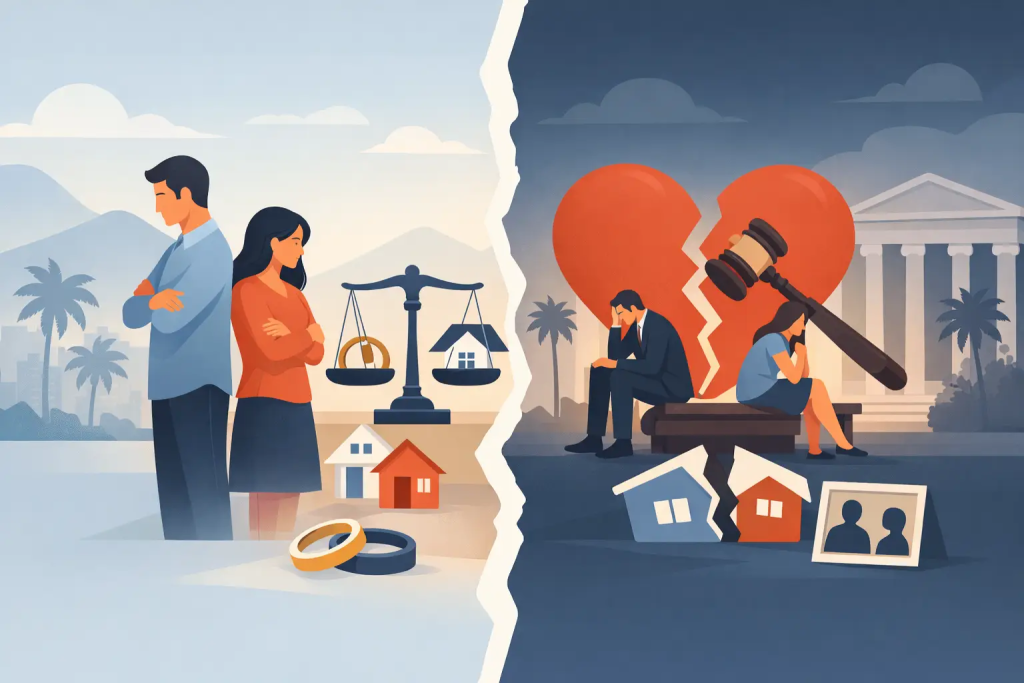
When a marriage is under strain, many people are not asking abstract legal questions. They are trying to figure out where they will live, how often they will see their children, whether health insurance will continue, and how to protect themselves financially. That is why the question of legal separation vs divorce matters so much. In California, both options can address custody, support, and property issues, but they do not lead to the same result.
For some families, legal separation offers breathing room and structure without fully ending the marriage. For others, divorce is the cleaner and more practical path. The right choice depends on your goals, your finances, and what kind of future you want to preserve or leave behind.
Legal separation vs divorce: what is the difference?
The clearest difference is simple. A divorce legally ends the marriage. A legal separation does not. If you obtain a divorce, you return to the status of an unmarried person and may remarry in the future. If you obtain a legal separation, you are still legally married even after the court makes orders about custody, child support, spousal support, and property.
That distinction affects more than just marital status. It can influence tax filing, insurance, retirement planning, inheritance rights, and religious or personal considerations. People sometimes assume legal separation is just a step on the way to divorce. It can be, but it does not have to be. In some cases, spouses remain legally separated for years.
In California, both legal separation and divorce can involve the same core family law issues. The court can still make enforceable orders about children, support, and division of debts and assets. So the difference is not whether the court can help. The difference is whether the marriage itself ends.
When legal separation may make sense
Legal separation can be the better fit when a couple needs legal clarity but is not ready, willing, or able to dissolve the marriage. One common reason is health insurance. If one spouse receives medical coverage through the other spouse’s employment, ending the marriage may affect eligibility. A legal separation may allow the couple to resolve financial and parenting issues while preserving that coverage, depending on the specific plan rules.
Another reason is religious or personal belief. Some people do not want a divorce for faith-based reasons, even when they no longer want to live as a married couple. Legal separation can provide court orders and practical protections without forcing a final break that conflicts with those beliefs.
There are also couples who want time. They may be fairly certain the relationship is over, but not ready to make the final legal move. In that situation, legal separation can establish rules around money, custody, and living arrangements so that uncertainty does not create further damage.
For some spouses, legal separation can also be useful when one party does not meet California’s residency requirements for divorce. A person can file for legal separation before they are eligible to file for divorce. Later, the case may be amended if divorce becomes the desired outcome.
Still, legal separation is not a way to avoid conflict automatically. If the case is contested, it can require just as much legal work, negotiation, and court involvement as a divorce.
When divorce may be the better option
If you know the marriage is over and you want finality, divorce is usually the more direct path. It gives both parties a clear legal ending point. That matters emotionally for many people, but it also matters practically. Once divorced, each person can move forward with financial planning, estate planning, and future relationships without the uncertainty of remaining married.
Divorce may also be the better option if one spouse wants to remarry at some point. Legal separation will not allow that. The marriage remains intact until a judgment of dissolution is entered.
In some cases, divorce is simply the cleaner financial choice. A prolonged legal separation can leave open questions about benefits, taxes, and long-term obligations. If there is no realistic chance of reconciliation and no strategic reason to stay married, ending the marriage may reduce confusion.
That does not mean divorce is always faster or easier. California has a six-month minimum waiting period before a divorce can be finalized, and contested cases can take much longer. But for many people, the benefit is certainty. There is a point at which the legal relationship is done.
Property, support, and children
One of the most misunderstood parts of legal separation vs divorce is the belief that legal separation offers less protection. In reality, a legal separation case can address many of the same major issues as a divorce case.
The court can make child custody and visitation orders based on the child’s best interests. It can order child support under California guidelines. It can also order spousal support where appropriate. In addition, the court can divide community property and debts.
That said, how these issues play out depends on the facts of the case. For example, if there are complicated assets, a family business, or disputes over income, the process may require detailed financial investigation regardless of whether the case is a legal separation or a divorce. The label does not reduce the need for preparation.
Parents should also understand that legal separation does not make custody matters informal. If children are involved, it is still important to get clear, enforceable orders. Ambiguity often leads to conflict, and conflict tends to become more expensive over time.
Practical issues people often overlook
Marital status affects more than the court file. That is why the legal separation versus divorce decision should be made carefully.
Taxes are one example. Remaining legally married may preserve certain filing options, but it may also create complications. The financial outcome depends on your income, deductions, and overall household circumstances.
Retirement and estate issues can also be affected. If you remain legally married, some rights and obligations may continue unless they are specifically addressed. That can matter if one spouse dies, changes beneficiaries, or accumulates additional assets.
Then there is day-to-day peace of mind. Some people feel more secure staying legally married while they sort out the next chapter. Others feel that remaining married keeps them tied to a relationship that is already over. Neither reaction is unusual. The legal answer and the personal answer are often connected.
Legal separation vs divorce in high-conflict situations
In high-conflict cases, the better option is usually the one that gives the clearest path to protection and enforceable orders. If there are serious disputes about children, finances, or personal safety, the main goal should not be preserving a label. It should be protecting rights and creating stability.
If domestic violence is involved, immediate legal protections may be necessary. In that setting, the question is not simply whether to choose legal separation or divorce. It is how to secure restraining orders, temporary custody arrangements, exclusive use of a home where appropriate, and support orders that protect the vulnerable party and the children.
High-conflict matters also benefit from careful documentation and experienced courtroom advocacy. A spouse may hope for a cooperative process, but family law cases do not improve because one side ignores financial misconduct, manipulation, or refusal to comply with court orders. Sometimes the best way to reduce long-term damage is to address the dispute directly and early.
How to decide what fits your situation
The right choice usually comes down to a few core questions. Do you want to remain legally married for insurance, religious, or personal reasons? Is there any realistic chance of reconciliation? Do you need immediate court orders but are not yet eligible for divorce? Or do you want finality and the freedom to fully separate your legal and financial life?
If you are unsure, that is normal. Many people start the process before they feel emotionally settled. What matters is getting clear advice based on your actual circumstances, not assumptions or secondhand stories. A decision that makes sense for one couple may be the wrong move for another.
An experienced family law attorney can help you look at the practical effects of each option, including support, property division, parenting arrangements, and long-term consequences. For clients in North County San Diego, firms such as Thomas D. Nares, APC often help people work through these choices in plain language so they understand not just the process, but the reason behind each step.
You do not need to have every answer before you speak with a lawyer. In many cases, the most useful first step is simply understanding what each path would mean for your home, your children, and your financial stability. Once that becomes clear, the next decision usually feels less overwhelming.
 EN
EN  ES
ES